The Challenge
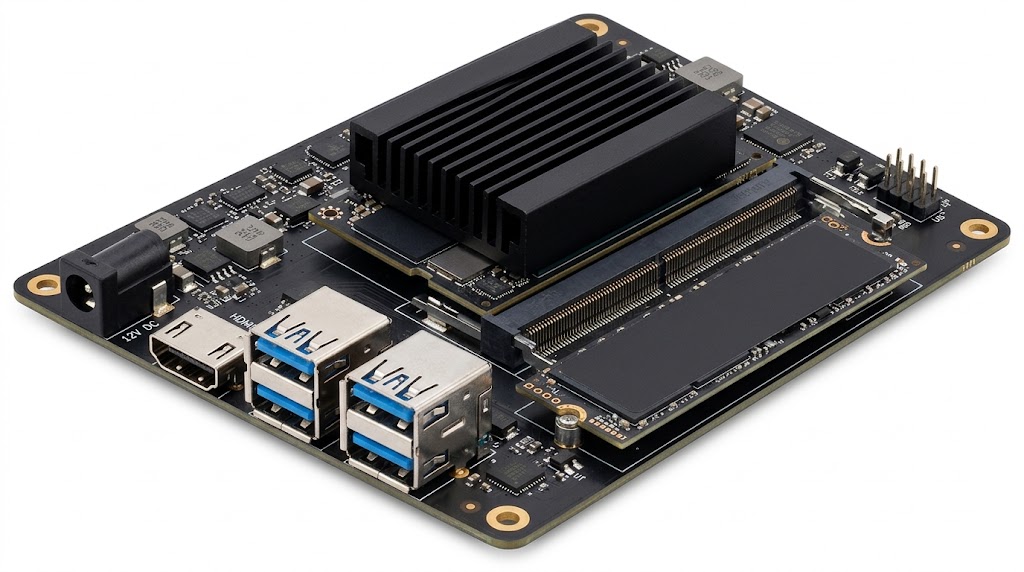
The client was building an AI-powered edge device around the NVIDIA Jetson Orin NX module and needed a carrier board tailored to their application. Generic development carriers were either too large for their enclosure or lacked specific interfaces — in particular, they needed PCIe x4 for an NVMe SSD, four USB 3.0 ports for peripherals, and HDMI for a display output, all within a compact form factor.
Power was a significant constraint: the Jetson Orin requires carefully sequenced multi-rail supply, and the system needed to operate from a 12V input while providing the module's 5V/4.7A main rail plus 3.3V and 1.8V auxiliary rails.
The Process
The design started with a thorough review of the NVIDIA Jetson Carrier Board Design Guide, which specifies the 260-pin SO-DIMM connector requirements, power-up sequencing, and signal integrity guidelines for PCIe and USB 3.x lanes.
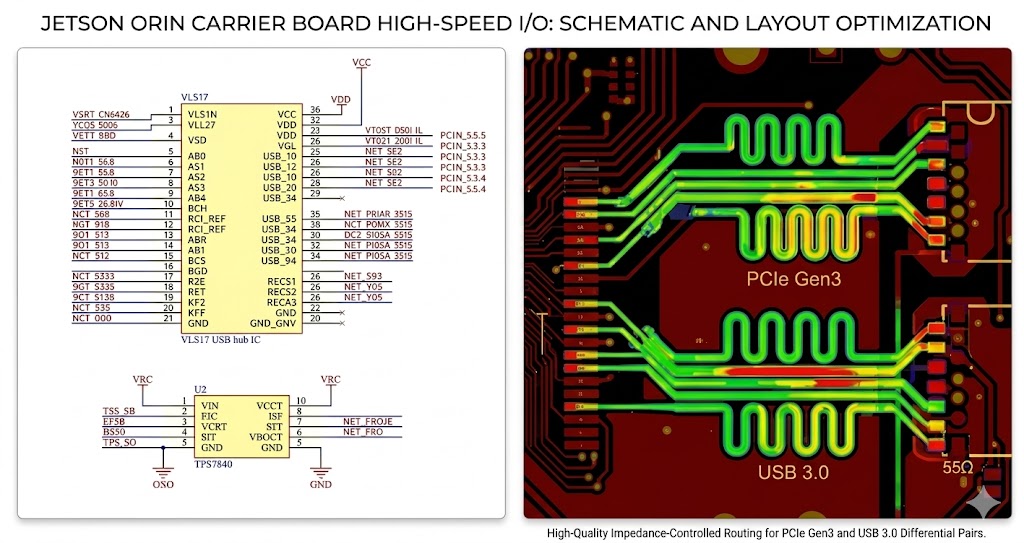
- Power Architecture: A TPS54620 synchronous buck converter provides the 5V main rail at up to 6A. A secondary TPS62130 handles the 3.3V rail. Power sequencing was implemented with a TPS3840 supervisor IC to meet Jetson Orin's strict sequencing requirements.
- PCIe x4: Four differential PCIe Gen3 pairs routed as controlled-impedance (85Ω differential) traces. Length-matched within 10 mil across all four lanes. AC coupling caps placed per NVIDIA guidelines.
- USB 3.0 x4: A VL817 USB 3.0 hub splits two USB 3.0 ports from the module into four downstream ports. SuperSpeed pairs routed at 90Ω differential.
- HDMI: HDMI 2.0 output via SN75DP130 retimer to improve signal integrity at 6Gbps data rate over the board-to-connector path.
The 6-layer PCB was laid out with dedicated signal, power, and ground planes. Via stubs on high-speed signals were back-drilled to remove stub resonances at PCIe Gen3 frequencies.
The Result
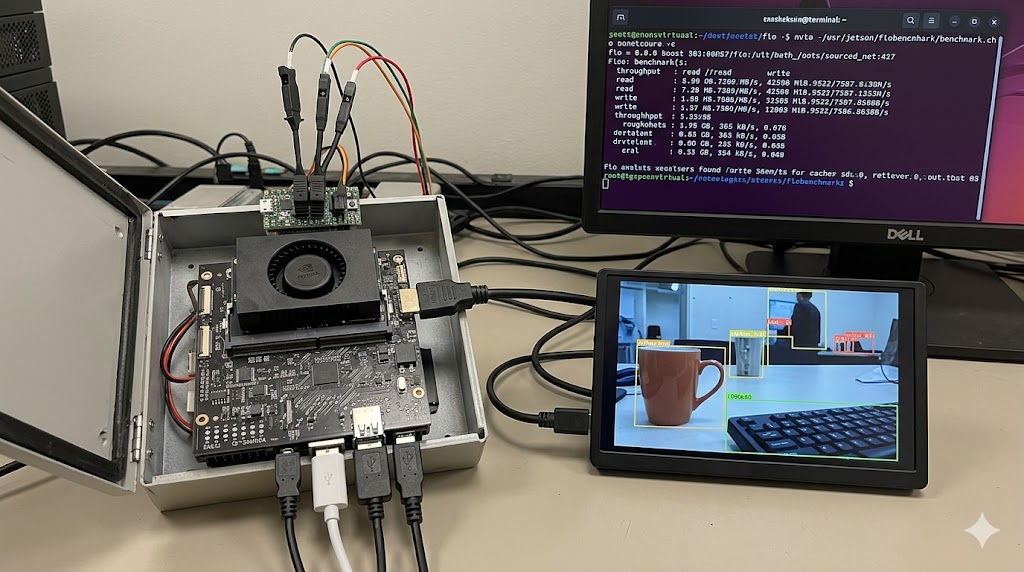
The carrier board came up successfully on first spin with no hardware rework required. PCIe NVMe was detected and operational immediately; USB 3.0 devices enumerated correctly on all four ports. HDMI displayed at 1080p60 without issues.
The compact board (115 × 80mm) fit perfectly in the client's enclosure, saving several months of development time compared to adapting a generic carrier. The client used this design as the basis for their production hardware, which went to contract manufacturing within six weeks of prototype validation.
- PCIe Gen3 x4 NVMe: 2.8 GB/s read, 2.1 GB/s write measured
- USB 3.0: 4 × USB-A ports, 430 MB/s throughput each
- Power: 12V input, multi-rail output, <300mV ripple
- Form factor: 115 × 80mm — custom enclosure fit